The Blast That Changed Everything: Chronic Dizziness, Brain Fog, and Severe Vestibular Decline After Explosion Injury

As a vestibular physical therapist, I have treated patients with vestibular disorders for many years, including individuals with Ménière’s disease, unilateral labyrinthine dysfunction, chronic dizziness, vestibular migraine, traumatic vestibular injuries, and post-concussive balance disorders. One of the most important principles I have learned clinically is this: objective balance testing matters. It provides measurable evidence of functional neurological impairment that extends far beyond subjective complaints alone.
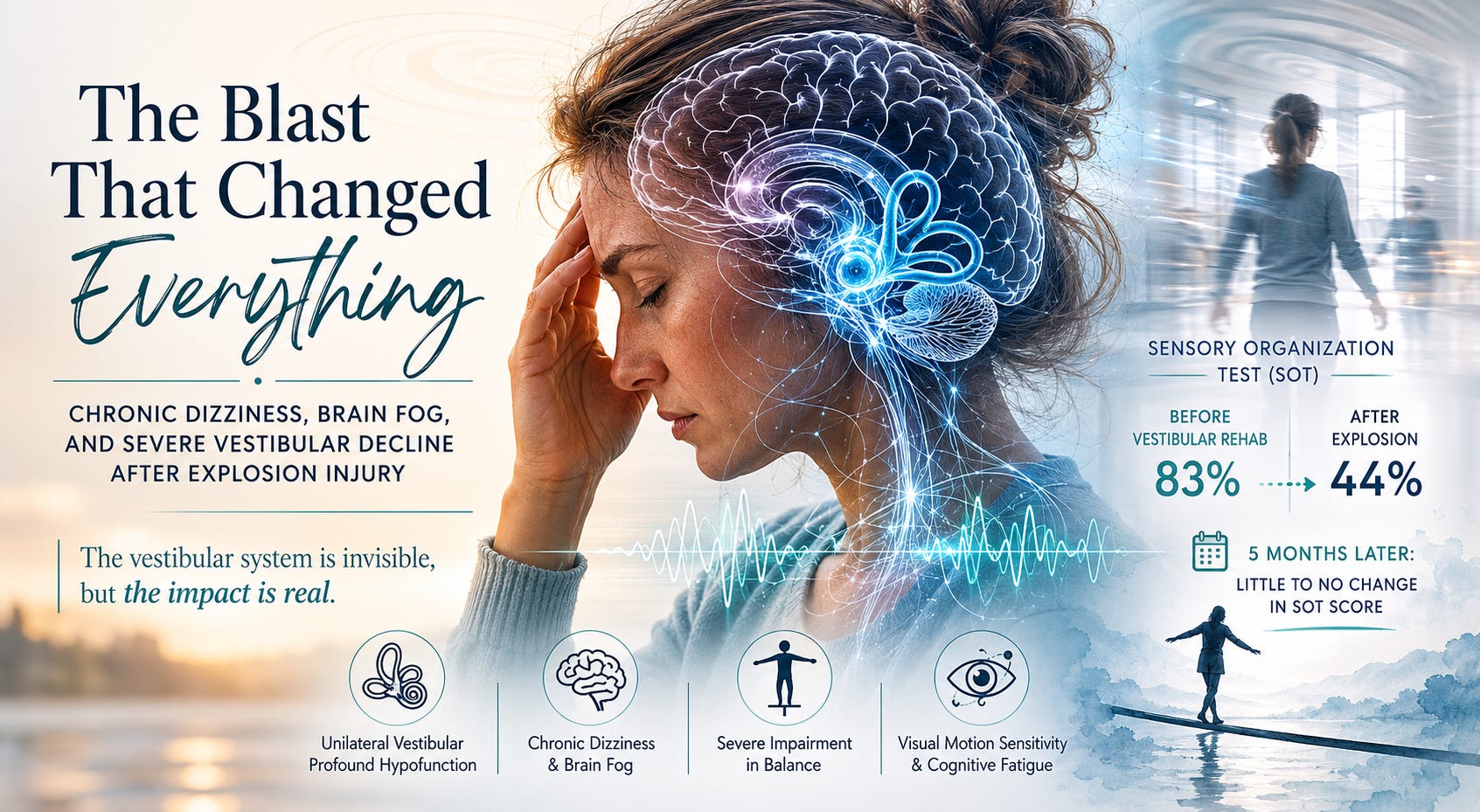
One case that strongly illustrates this involved a patient who had previously undergone vestibular rehabilitation for Ménière’s disease and had demonstrated substantial functional recovery prior to a traumatic explosion event. Before the explosion, this patient had improved to an 83% composite score on the Sensory Organization Test (SOT) following vestibular rehabilitation. Functionally, this score reflected a compensated vestibular system with significantly improved postural control and sensory integration.
Then everything changed.
After involvement in a closed-room explosion, the patient returned with profound dizziness, disequilibrium, visual motion sensitivity, impaired balance, cognitive slowing, and persistent “brain fog.” Repeat computerized dynamic posturography demonstrated a dramatic decline to a 44% composite score on the Sensory Organization Test, representing severe impairment in postural stability and vestibular integration.
This decline was not subtle. It was profound.
From a clinical standpoint, this type of measurable deterioration following blast exposure is highly significant. The patient had previously demonstrated objective improvement and functional compensation after vestibular rehabilitation. The post-explosion testing showed a marked breakdown in the patient’s ability to appropriately utilize vestibular, visual, and somatosensory input for balance control.
The vestibular system is extraordinarily vulnerable to blast-related injury. Research has demonstrated that blast exposure can disrupt vestibular sensory organs, vestibulo-ocular reflex pathways, and central sensory integration mechanisms responsible for postural control and spatial orientation. Patients exposed to blast injuries frequently report chronic dizziness, imbalance, visual dependence, cognitive fatigue, motion sensitivity, and difficulty concentrating.
Importantly, vestibular dysfunction does not simply affect balance. It affects cognition.
A growing body of literature now supports the relationship between vestibular dysfunction and cognitive impairment, including deficits involving attention, executive function, spatial memory, concentration, and mental processing speed. Many patients describe this symptom constellation as “brain fog.”
In chronic unilateral vestibular hypofunction, the brain is forced to constantly compensate for inaccurate or asymmetrical sensory information. This creates a continuous neurological workload that can contribute to mental fatigue, sensory overload, impaired concentration, and reduced functional endurance throughout the day.
Clinically, I often explain this to patients in practical terms: the brain is having to work excessively hard simply to maintain orientation and equilibrium. Tasks that once were automatic — walking through crowds, driving, turning the head quickly, processing visual information, or working in busy environments — now require significant neurological effort. Over time, this can become exhausting physically, cognitively, and emotionally.
Blast-related vestibular injuries may involve both peripheral and central neurological dysfunction simultaneously. Research involving blast exposure and mild traumatic brain injury has demonstrated persistent vestibular dysfunction, impaired postural stability, dizziness, and cognitive symptoms long after the initial injury.
The dramatic decline from an 83% SOT composite score to 44% objectively supports a major loss of functional balance integration following the explosion event. In vestibular rehabilitation, the Sensory Organization Test is designed to evaluate how effectively an individual utilizes vestibular, visual, and somatosensory input to maintain upright stability under progressively complex sensory conditions. Lower composite scores reflect impaired sensory integration and increased postural instability.
In my professional opinion, this type of objective decline is entirely consistent with significant vestibular decompensation following blast exposure. It also correlates strongly with the patient’s persistent reports of dizziness, imbalance, cognitive fatigue, motion sensitivity, and chronic brain fog.
What is often misunderstood by individuals outside vestibular medicine is that dizziness is not a minor symptom. Persistent vestibular decompensation can significantly impair balance, cognition, gait stability, visual processing, occupational function, and quality of life. Patients may struggle with walking in visually busy environments, driving, multitasking, concentration, physical endurance, work activities, and social participation. Many develop anxiety and hypervigilance because the nervous system remains in a constant state of sensory threat detection.
Even more importantly, patients often appear “normal” externally despite profound internal dysfunction. This discrepancy can lead to misunderstanding of the severity of their symptoms and limitations.
Vestibular rehabilitation remains one of the most important treatment approaches for unilateral vestibular hypofunction and post-traumatic vestibular dysfunction. Research has repeatedly demonstrated improvement in dizziness, postural control, and functional balance performance following vestibular rehabilitation interventions.
However, recovery after blast injury is often prolonged and incomplete.
Five months after the explosion, repeat objective balance testing demonstrated little to no meaningful improvement in the patient’s Sensory Organization Test performance. Clinically, this is significant. While vestibular rehabilitation can greatly improve many cases of unilateral vestibular hypofunction, there are times when the vestibular system is so profoundly damaged that complete neurological compensation does not occur. In these cases, patients may continue to experience chronic dizziness, imbalance, visual motion sensitivity, cognitive fatigue, and persistent brain fog long after the original injury.
The persistence of severe impairment over time supports the presence of chronic vestibular dysfunction rather than temporary symptom exaggeration or transient imbalance. Objective computerized balance testing demonstrated sustained physiological impairment consistent with significant vestibular injury following blast exposure.
This is why objective testing matters.
The patient’s post-explosion decline on the Sensory Organization Test was not merely subjective perception — it represented measurable evidence of severe deterioration in vestibular-mediated postural control following the traumatic event. In cases involving vestibular injury, computerized dynamic posturography provides critical clinical evidence connecting physiological dysfunction with real-world functional impairment.
As vestibular clinicians, we must recognize that profound unilateral vestibular hypofunction after blast exposure is not simply a complaint of dizziness. It is a complex neurological disorder capable of affecting balance, cognition, emotional well-being, visual processing, gait stability, occupational performance, and overall quality of life for years after the initial trauma.
References
Hoffer ME, Balough BJ, Gottshall KR. Posttraumatic balance disorders. Int Tinnitus J. 2007.
Kontos AP, Deitrick JM, Collins MW, Mucha A. Review of vestibular and oculomotor screening and concussion rehabilitation. J Athl Train. 2017.
Smith PF, Zheng Y. From ear to uncertainty: vestibular contributions to cognitive function. Front Integr Neurosci. 2013.
Bigelow RT, Agrawal Y. Vestibular involvement in cognition: visuospatial ability, attention, executive function, and memory. J Vestib Res. 2015.
Alsalheen BA, Mucha A, Morris LO, et al. Vestibular rehabilitation for dizziness and balance disorders after concussion. J Neurol Phys Ther. 2010.
Gurley JM, Hujsak BD, Kelly JL. Vestibular rehabilitation following mild traumatic brain injury. NeuroRehabilitation. 2013.
Whitney SL, Rossi MM. Efficacy of vestibular rehabilitation. Otolaryngol Clin North Am. 2000.
Jacobson GP, Newman CW, Kartush JM. Handbook of Balance Function Testing. Mosby Publishing.
Nashner LM. Computerized Dynamic Posturography. In: Handbook of Balance Function Testing. Mosby.
Herdman SJ, Clendaniel RA. Vestibular Rehabilitation, 4th Edition. F.A. Davis Company.
Thank you. I prefer the term cognitive impairments to brain fog because fog usually goes away eventually but these impairments often don’t. I knew one person with MdDS who was working in the American military and got triggered by a blast during training. He had a terrible time in his unit with people accusing him of faking symptoms to get out of training and active duty and of being a coward. Thankfully he got a new commanding officer who had training in physiotherapy and got him accurately diagnosed and treated very quickly and although he hasn’t been able to return to active duty he now works with army and navy veterans with similar injuries and in suicide prevention in this population. One paper I cite a lot which might be of interest to you is this UK paper Smith RM, Burgess C, Tahtis V, et al
Why are patients with acute traumatic brain injury not routinely assessed or treated for vestibular dysfunction in the UK? A qualitative study
BMJ Open 2023;13:e067967. doi: 10.1136/bmjopen-2022-067967 which had very good patient/public involvement and I’m pleased to say that there has been an improvement in screening since it was published although not as much as we need here.